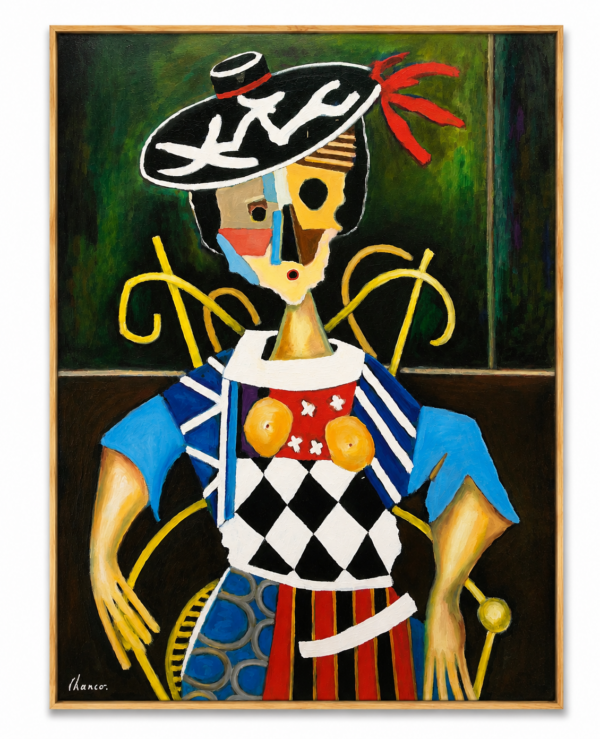
Created in 1972, Portrait of Mathilde is a striking example of Roland Chanco’s celebrated Kaleidoscopic period, in which the French painter developed his distinctive language of fragmented forms, mask-like faces and intensely expressive colour.
The female figure dominates the composition, constructed through bold geometric planes, contrasting patterns and brilliant passages of blue, red, yellow, black and white. Her elaborate costume and extraordinary hat lend the portrait an almost theatrical quality. Chanco transforms the conventional portrait into a vivid interplay of personality, colour and abstraction, while retaining the recognisable presence of his sitter.
The painting dates from one of the most distinctive periods of Chanco’s career. Between approximately 1961 and 1975, the artist developed what became known as his Kaleidoscopic period, inspired by the principle of multiple reflections. Human figures were reconstructed through fractured shapes and saturated colour, producing the highly individual visual language for which Chanco became particularly recognisable.
Born Roland Chanconnier in Reignac, France, in 1914, Chanco moved to Paris as a young man and became part of the artistic world of Montmartre. There he encountered artists including Maurice Utrillo, Gen Paul and Pablo Picasso. Picasso reportedly admired the strength and individuality of Chanco’s paintings. After moving to the Côte d’Azur in 1947, Chanco continued his association with Picasso and entered a remarkable artistic circle that also included Joan Miró, Jean Cocteau and Jacques Prévert. He additionally worked on ceramics in Pierre Lebasque’s studio alongside Marc Chagall.
One of the most extraordinary episodes in Chanco’s career came in 1960, when, seeking complete artistic renewal, he destroyed the greater part of his earlier painted œuvre. The radical decision preceded the development of the Kaleidoscopic works to which this 1972 portrait belongs.
Portrait of Mathilde therefore belongs to an important and immediately recognisable chapter of Chanco’s artistic development: a work combining the legacy of post-Cubism and Expressionism with the artist’s own exuberant approach to colour and the human figure.
Oil on canvas, 1972.
Signed lower left.
Original artwork.