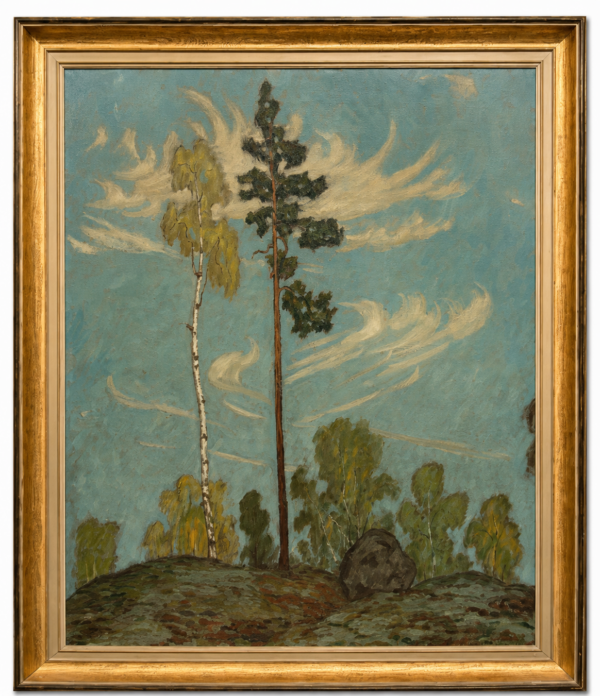
Gustave Frangerst’s Northern Wind (1972) is an atmospheric Scandinavian landscape in which a solitary pine and slender birch rise above a rocky terrain beneath an expansive, windswept sky.
It is the sky that gives the painting its distinctive character. Against a cool turquoise-blue ground, long sweeping passages of white paint describe clouds driven by the wind. Their almost calligraphic movement contrasts beautifully with the stillness of the rock and earth below, creating a subtle tension between permanence and change.
Frangerst works with a restrained northern palette of blue, moss green, ochre, grey and earthy brown. Rather than pursuing meticulous naturalistic detail, he simplifies individual elements into expressive forms, allowing atmosphere and rhythm to become as important as the landscape itself.
About Gustave Frangerst
Gustave Frangerst was a Scandinavian artist associated with the northern European landscape tradition and active during the second half of the twentieth century.
His painting reflects the particular sensitivity to nature characteristic of Scandinavian art: an interest not simply in depicting a specific location, but in communicating the experience of light, weather, solitude and the changing seasons.
Frangerst’s landscapes are distinguished by their economical compositions and emphasis on the relationship between land and sky. Trees, rocks and distant vegetation frequently function as structural elements, while broad areas of open space give his paintings their characteristic sense of tranquillity.
Working during a period when Scandinavian artists increasingly combined traditional landscape painting with the freedoms of twentieth-century modernism, Frangerst simplified natural forms while retaining an immediate connection to the observed world. His approach favours atmosphere and expressive brushwork over photographic precision.
Northern Wind, painted in 1972, is particularly successful in this respect. The landscape contains relatively few elements, yet each has a clear role within the composition. The two trees become almost symbolic figures standing against the immense northern sky, while the movement of the clouds suggests the invisible force of the wind passing through the landscape.
Presented in its gilt frame, the work has an elegant presence and a particularly appealing balance between traditional landscape painting and twentieth-century Nordic modernism.
Oil on canvas, 1972.
93 × 75 cm framed.
Original artwork.