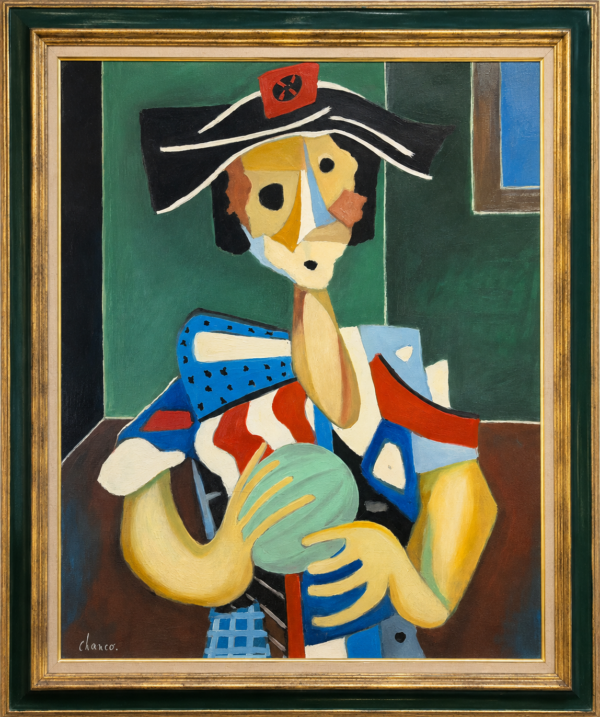
Created in 1976, this striking figurative work by Roland Chanco belongs to the mature phase of the artist’s distinctive exploration of the human figure, following the celebrated Kaleidoscopic period that defined much of his work from the 1960s to the mid-1970s.
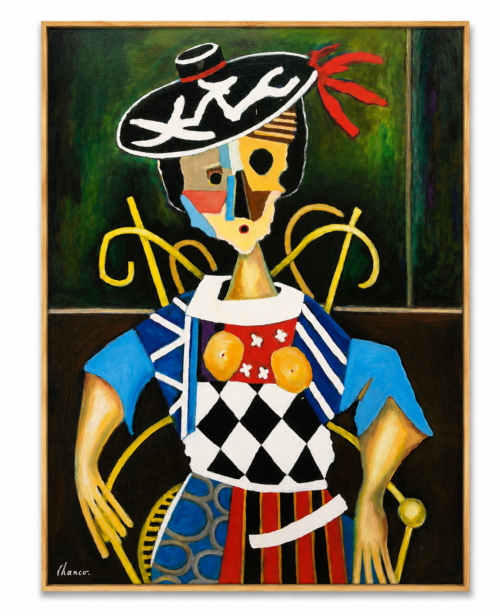
The composition presents a solitary figure in an elaborate costume and broad-brimmed hat, constructed through simplified geometric forms and an exceptionally controlled arrangement of colour. Deep greens provide a restrained architectural background against which vivid passages of blue, red, yellow and pale turquoise give the figure an almost theatrical presence.
The fragmented, mask-like face is unmistakably characteristic of Chanco’s visual language. Rather than pursuing conventional likeness, he reduces the human figure to interlocking planes, exaggerated proportions and expressive colour. The result reflects the influence of twentieth-century modernism while remaining highly individual.
Born Roland Chanconnier in Reignac, France, in 1914, Chanco moved to Paris as a young artist and entered the artistic milieu of Montmartre. There he encountered figures including Maurice Utrillo, Gen Paul and Pablo Picasso. Chanco knew Picasso personally, and their contact continued after Chanco settled on the Côte d’Azur in 1947. His wider artistic circle in southern France included Joan Miró, Jean Cocteau and Jacques Prévert, while he also explored ceramics in Pierre Lebasque’s studio alongside Marc Chagall.
A decisive moment came in 1960, when Chanco destroyed much of his earlier painted œuvre in pursuit of a new artistic direction. The following years produced his celebrated Kaleidoscopic period, characterised by fractured forms, mask-like faces and intense chromatic contrasts. This 1976 painting demonstrates how Chanco carried those discoveries forward into a more monumental and composed treatment of the figure.
The painting’s harlequin-like geometry, theatrical costume and stylised face also reveal Chanco’s fascination with performance, disguise and identity — themes deeply rooted in the visual vocabulary of European modernism.
Chanco continued painting throughout an extraordinarily long career and died in 2017 at the age of 103. His extensive œuvre encompasses more than 2,000 paintings and hundreds of works on paper documented in his catalogue raisonné.
An immediately recognisable example of Roland Chanco’s mature figurative language, combining the legacy of Cubism and Expressionism with the artist’s distinctive sense of colour, character and theatricality.
Oil on canvas, 1976.
Signed lower left.
Original artwork.