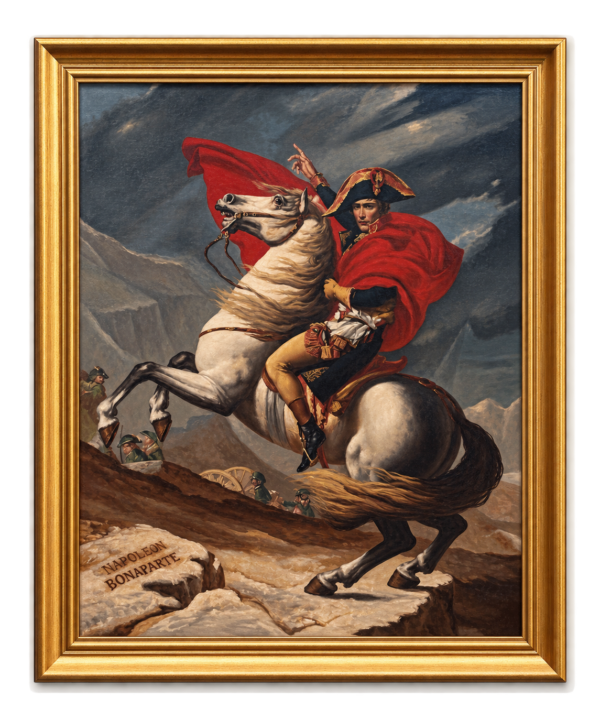
Sergey Ignatenko’s Napoleon Bonaparte (2020) is a dramatic historical composition that combines the visual language of European equestrian portraiture with the artist’s accomplished contemporary realist technique.
Napoleon dominates the composition on a powerful rearing white horse, set against a turbulent mountainous landscape. His brilliant red cloak sweeps across the centre of the painting, creating an immediate focal point against the cool greys and blues of the storm-filled sky. The theatrical movement of fabric, horse and rider gives the work a sense of momentum and heroic scale despite its relatively intimate dimensions.
Ignatenko pays particular attention to the physical presence of the horse: its muscular body, raised forelegs and animated expression amplify the drama of the scene. Napoleon, by contrast, remains composed and commanding, creating a deliberate tension between the energy of the animal and the controlled authority of its rider.
The painting belongs to the long European tradition of equestrian and military portraiture, in which the mounted figure becomes an image of leadership, ambition and power. Ignatenko approaches this historical vocabulary through his own highly polished figurative technique, combining carefully modelled forms with strong contrasts of light, colour and atmosphere.
The composition also enters into dialogue with one of the most recognisable images of Napoleon in Western art: the tradition established by Jacques-Louis David’s celebrated equestrian portraits of Napoleon crossing the Alps. Rather than functioning simply as a historical reconstruction, Ignatenko’s painting can be understood as a contemporary interpretation of this enduring iconography.
About Sergey Ignatenko
Sergey Ignatenko (b. 1975, Gomel, Belarus) is a contemporary figurative painter known for technically accomplished compositions combining academic drawing, dramatic light and a distinctly painterly sensibility.
Ignatenko studied painting at the Gomel Art College, graduating in 1995, before continuing his education at the Belarusian State Academy of Arts in Minsk, where his teachers included important figures of Belarusian painting such as Mai Dantsig and Mikhail Savitsky. He graduated from the Academy in 2002 and subsequently returned to Gomel, where he also taught painting.
His artistic practice encompasses portraiture, the female figure, genre scenes and historically inspired subjects. Although firmly grounded in academic training, Ignatenko frequently introduces elements of Impressionist freedom and theatrical lighting, allowing his paintings to move beyond strict realism.
During his career, Ignatenko’s work has been presented internationally, with exhibitions and gallery representation extending beyond Belarus to Europe and the United States. He received an Honourable Mention at the American Juried Art Salon in Dallas in 2006, and his portrait of his former teacher Mai Dantsig entered the collection of the National Art Museum of Belarus.
Created in 2020, Napoleon Bonaparte demonstrates another dimension of Ignatenko’s figurative practice. Here, technical precision is combined with historical spectacle: the monumental horse, dramatic red cloak and turbulent Alpine setting transform a familiar historical figure into a visually commanding contemporary painting.
Presented in a classical gilt frame, the work reinforces its connection with the European tradition of historical painting while remaining unmistakably a twenty-first-century interpretation.
Oil on canvas, 2020.
82 × 72 cm including frame.
Original artwork.