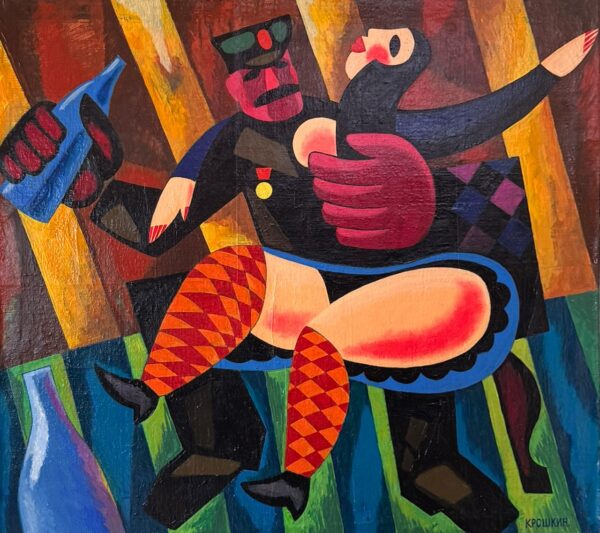
Bold, colourful and immediately recognisable, Oleg Kroshkin’s work combines Pop Art, graphic language and irony with a distinctive Eastern European character.
His paintings are built around simplified human figures, powerful silhouettes, saturated colour and an almost poster-like clarity of composition. Kroshkin frequently transforms scenes of everyday life into theatrical narratives populated by exaggerated characters — dancers, couples and social figures whose gestures convey humour, intimacy and sometimes subtle irony.
Rather than pursuing conventional realism, Kroshkin reduces the human body to a vocabulary of geometric forms. Strong outlines, flattened perspective and decorative pattern bring his compositions close to the visual language of Pop Art and graphic design, while their humour and narrative quality remain rooted in the particular cultural atmosphere of Eastern European figurative painting.
In Dancing Time (2001) these qualities are especially apparent. The dancing couple, oversized hands, patterned stockings and bottle become part of a tightly constructed visual rhythm. The painting is playful at first glance, but its sophisticated organisation of colour and form reveals a highly deliberate artistic language.