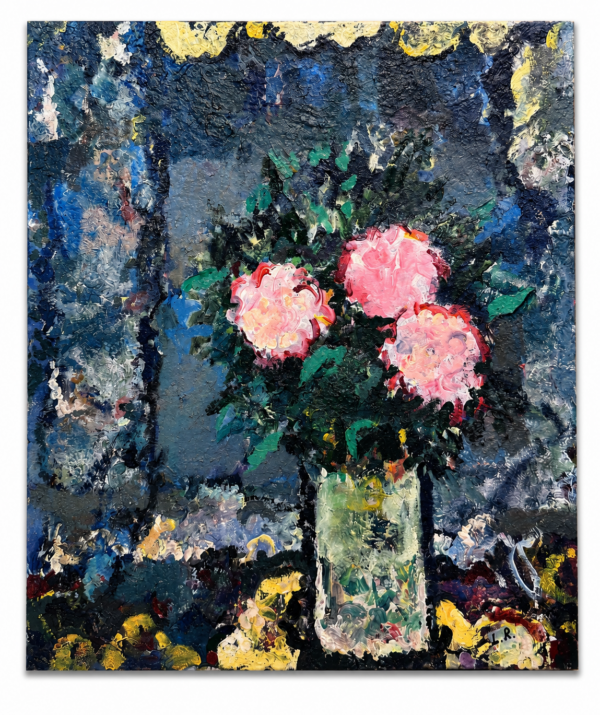
Leo Rotko’s Pink Flowers (2001) transforms the traditional floral still life through an intensely expressive use of colour, texture and impasto.
Three luminous pink blossoms emerge from a dense, almost nocturnal field of deep blues, greens and greys. Their delicately modulated pinks provide a vivid focal point within a composition otherwise dominated by darker, cooler tones. The flowers are recognisable yet deliberately freed from botanical precision: Rotko constructs them through energetic passages of pigment rather than careful descriptive detail.
The physical surface of the painting is particularly important. Oil paint is applied generously across the canvas, creating a richly textured field in which individual strokes, ridges and accumulations of pigment remain visible. The vase itself appears to dissolve into this surrounding painterly activity, shifting between recognisable object and abstraction.
This tension between figuration and abstraction is central to the work. Viewed from a distance, the composition resolves clearly into flowers arranged in a vase; seen more closely, the image becomes an intricate network of colour, gesture and texture. Small passages of yellow, turquoise, violet, white and burgundy animate the darker background and give the entire surface a sense of movement.
Born in 1951, Leo Rotko developed an expressive approach to painting in which the physical character of oil paint plays a central role. Across his figurative and still-life compositions, recognisable subjects provide a structure through which colour and material can acquire an increasingly independent expressive presence.
Created in 2001, Pink Flowers demonstrates this approach particularly effectively. Rotko takes one of the oldest subjects in European painting — flowers in a vase — and treats it not as a conventional decorative still life, but as an exploration of luminosity, surface and colour.
The contrast between the brilliant flowers and the richly worked blue background gives the painting an unusual visual depth: intimate in subject, yet powerful in its material presence.
Oil on canvas, 2001.
80 × 70 cm.
Initialled lower right.
Original artwork.